
Bryan County Court Records After a Jail Arrest
After a Bryan County jail arrest, the first public record may be the jail booking entry. That entry can list a name, booking date, inmate ID, charges entered at intake, and a booking photo when one is available. The court record starts later in a different office. Bryan County is in Oklahoma District 19, and District Attorney Tim Webster's office decides whether to file state criminal charges after arrest. Once a complaint, information, indictment, or related filing is accepted in Bryan County District Court, the Court Clerk maintains the permanent case record.
The custody side and the court side answer different questions. Use jail inmate records to confirm whether a person is currently held at Bryan County Jail, and use jail mugshots for booking-photo access and limits. Use court records after an arrest to confirm the filed counts, case number, docket dates, warrant entries, payments, dismissals, pleas, or other disposition. Booking charges can be revised, reduced, expanded, or declined after DA review.
How to Find Bryan County Court Records After an Arrest
The Bryan County Court Clerk page links to ODCR, On Demand Court Records, as the local court-records search channel. ODCR includes Bryan County in its court dropdown and lets users search by party name, case type, full case number, filed date, and activity date. OSCN is another Oklahoma court docket path, but automated research reached a turnstile, so ODCR is the more documented public search route for this page. Arrest and booking details remain on the sheriff's jail roster; filed criminal counts and case events belong in the court index.
- Open the ODCR court-search portal from the Bryan County Court Clerk's "Search Court Records" link.
- Select Bryan in the court field when narrowing the search, or start broad if the arrest may involve another Oklahoma court.
- Search the defendant name in Last, First format, or enter the full case number if it appears on bond paperwork.
- Open the case and compare the filed charge list with the jail booking charges.
- Check each count for its current status, docket activity, court dates, payments, warrants, and disposition.
ODCR is a case-record search, not a full criminal-history product. Oklahoma court records are generally public unless a statute makes them confidential or a court seals them, but a background check used for employment, tenant screening, credit, insurance, or another FCRA-covered purpose requires a compliant consumer-reporting process, not a casual docket search.
The ODCR search interface shows the public fields used to narrow Bryan County criminal cases.
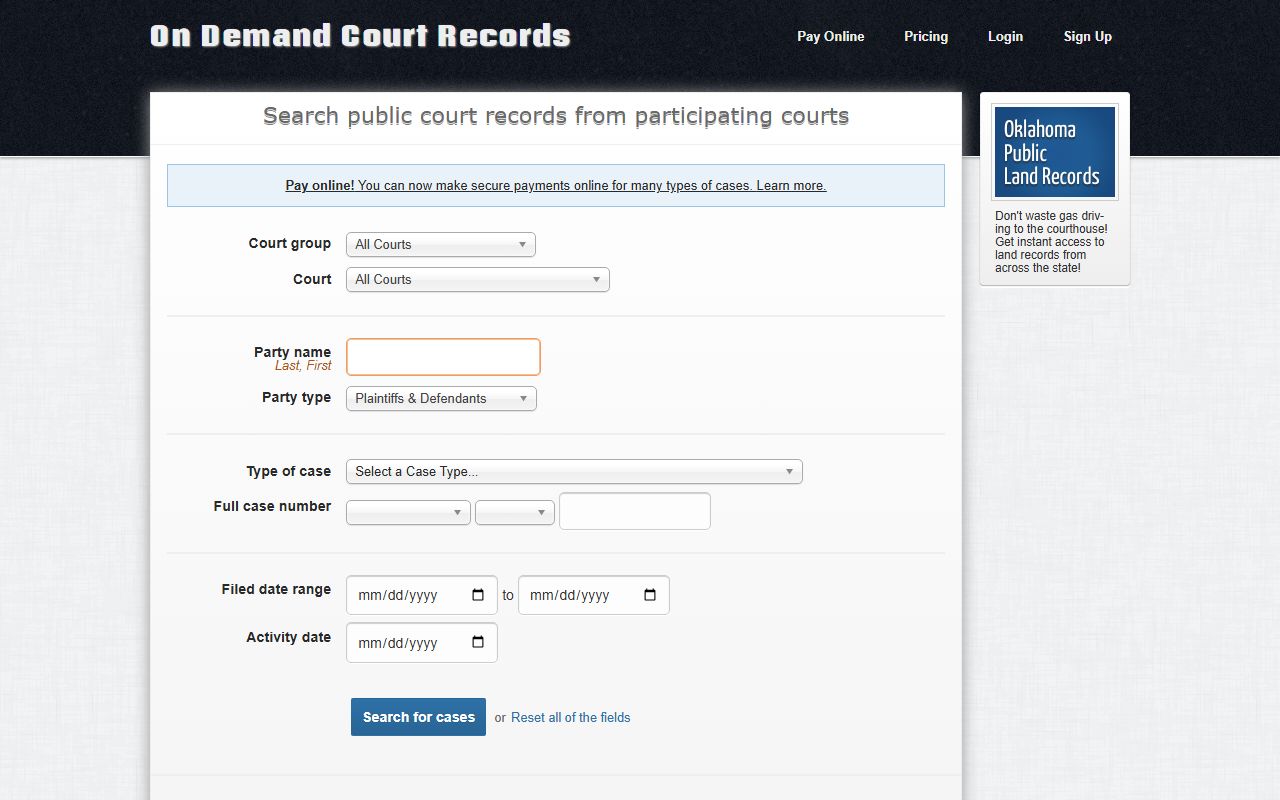
The ODCR screen is most useful when a jail arrest has become a filed case, because the search can be limited by court, party name, case type, case number, filed date, or activity date.
| ODCR Field | How It Helps After a Jail Arrest |
|---|---|
| Court group | Can limit results to Oklahoma District Courts or show all participating courts. |
| Court | Includes Bryan County and other Oklahoma county or tribal courts. |
| Party name | Searches the defendant or other party, with the label using Last, First format. |
| Party type | Can search plaintiffs and defendants or all parties when the role is uncertain. |
| Type of case | Includes criminal felony, criminal misdemeanor, criminal probable cause, traffic, search warrant, and habeas case types. |
| Full case number | Best when a case number appears on bond paperwork, clerk paperwork, or a court notice. |
| Filed date range | Useful when the arrest date is known but the case was filed later. |
| Activity date | Finds cases with recent docket movement, including hearings or warrant activity. |
How Charges Get Filed After an Arrest: Complaint, Information, and Indictment
The roster charge is a custody label entered at booking. The charging document is what turns the post-arrest allegation into a court case. Oklahoma criminal procedure recognizes prosecution by indictment or information for public offenses, with exceptions and case-specific rules. In practical Bryan County District Court use, formal charges commonly appear through a complaint or information filed by the district attorney. An indictment comes from a grand jury process and is less common in ordinary county-level case searches.
| Complaint | Information | Indictment | |
|---|---|---|---|
| Filed By | Often tied to law-enforcement facts and prosecutor review. | District attorney as the formal prosecuting office. | Grand jury process. |
| Common Use | Early criminal filing or probable-cause style filing. | Common charging instrument for many Oklahoma criminal prosecutions. | Less common; used when a grand jury returns charges. |
| Relation to Booking | May follow the arrest facts listed by the jail. | May amend or replace the booking charge description. | May arise from investigation beyond the booking event. |
| Record Value | Shows what is being alleged in court. | Shows the counts the prosecutor asks the court to track. | Shows grand-jury returned allegations. |
Charge Status and What It Means
Charges can change after the arrest because the DA has to evaluate reports, probable cause, evidence, witness information, and legal fit. A booking charge may be broad or preliminary. A filed court count may be narrower, more serious, reduced, amended, dismissed, or replaced with another count. Always read the docket and the final disposition before treating a charge as the outcome.
| Status | What It Means |
|---|---|
| Pending | The filed count is still active and has not reached a final plea, verdict, dismissal, or other disposition. |
| Amended | The prosecutor or court record changed the wording, statute, level, or count structure from an earlier filing. |
| Reduced | The case moved from a higher charge or level to a lesser charge or lesser offense category. |
| Dismissed | The count or case was terminated without a conviction on that count, subject to the wording of the order. |
| Nolle Prosequi | The prosecutor declined to continue that charge; the docket should be read for whether it applies to one count or the entire case. |
| Disposed | The court has entered an outcome, which may be a plea, conviction, acquittal, dismissal, deferred result, or other final event. |
Bond and Release After an Arrest
Bond information is not guaranteed on the public Bryan County Jail profile. The sample profile inspected did not show a bond amount, so the better local path is to check the jail profile, call the jail at (580) 931-0673 when the public record is unclear, and review ODCR or Court Clerk records once a case has opened. The sheriff's bondsmen page warns that bonds not filled out or notarized properly will not be accepted, approved, or filed by the court clerk, and the defendant can be subject to re-arrest. It also says bonds must include case numbers after cases have been filed.
| Bond Type | How It Works |
|---|---|
| Cash Bond | Full cash or approved payment is posted as required by the court or jail process. |
| Surety Bond | A licensed bondsman posts surety, with paperwork completed, notarized where required, and tied to the case number once filed. |
| PR / Own Recognizance | The person is released on a promise to appear and conditions set by court order, without posting the full bond amount. |
| Property Bond | Property may be pledged where allowed and approved, but the Bryan sheriff page does not give a local step-by-step process. |
| No-Bond Hold | Payment will not release the person because a court order, warrant, detainer, or another agency hold controls custody. |
Warrants That Lead to an Arrest
A warrant becomes part of the jail-population picture when the person is arrested and booked. Bryan County Sheriff's Office publishes a Most Wanted page, but research did not locate a separate searchable active-warrant database. The most-wanted page warns that listed information is not represented as current for any legal purpose and that no one should attempt to apprehend a wanted person. For court-related warrants, search ODCR or OSCN for bench-warrant, failure-to-appear, search-warrant, or fugitive-warrant activity, then contact the Court Clerk or sheriff as appropriate.
For Bryan County questions, the sheriff main line is (580) 924-3000. The Court Clerk can answer district-court record questions at (580) 924-1446. Durant Police matters may have separate municipal handling, and its official city page lists after-hours bond payment and police records routes rather than a separate jail roster.
Charges vs. Convictions
An arrest, a booking charge, and a filed charge are accusations or procedural events. A conviction requires a plea, verdict, or qualifying court disposition. This distinction matters when reading court records after a jail arrest because a case can show several counts, amended counts, dismissed counts, and one final outcome.
| Charge | Conviction | |
|---|---|---|
| Stage | Accusation listed at booking or filed in court. | Outcome entered after plea, verdict, or other qualifying disposition. |
| Proof Level | May begin from probable cause or prosecutor filing standards. | Requires the legal standard tied to conviction, commonly beyond a reasonable doubt for trial. |
| Can Change? | Yes. Charges may be amended, reduced, added, or dismissed. | The final record can still be appealed, corrected, sealed, or otherwise affected by later court action. |
| How to Read It | Do not treat it as guilt. | Confirm the count, date, sentence, and any deferred or suspended terms in the docket. |
Sealed vs. Expunged Arrest Records
Oklahoma law allows eligible arrest and case records to be sealed through a court process under Title 22 expungement provisions. Sealing is not automatic just because a charge was dismissed, declined, or reduced. A court order controls what is restricted, which agencies must act, and whether the public court index changes. Oklahoma court records are public under the Open Records Act unless a statute or sealing order restricts access.
| Sealed | Expunged | |
|---|---|---|
| Public Visibility | Hidden or restricted from ordinary public access under the court order. | Common public wording for Oklahoma record clearing, usually implemented through sealing/restriction rather than automatic destruction. |
| Record Holders | May apply to court files, law-enforcement records, or other agencies named in the order. | Depends on the exact Oklahoma expungement order and eligible record category. |
| Eligibility | Depends on Title 22 criteria, disposition, waiting periods, and case facts. | Requires a petition or court process when the statute allows it. |
| Practical Limit | Private copies, screenshots, or third-party reposts may not disappear immediately. | A dismissed case is not automatically removed from every system without the required order. |
Background Check Considerations
ODCR, Court Clerk records, jail records, and sheriff records requests are public-record access channels. They are not a substitute for a legally compliant background check when the purpose is employment, housing, credit, insurance, licensing, or another regulated decision. Public court records after an arrest can also be incomplete if a case is sealed, juvenile, still pending, misindexed, or filed under a different name or case number.
Important: Bryan County Inmate Population is not a consumer reporting agency and may not be used for FCRA-covered decisions.
Restricted Court Records After an Arrest in Bryan County
Some records after a Bryan County arrest may be unavailable or incomplete in public search. Juvenile matters, sealed cases, certain victim information, active investigative material, and records made confidential by statute may be withheld or limited. Law-enforcement records under Oklahoma's Open Records Act include specified arrest facts and arrestee descriptions, but that does not make every internal report, investigative note, or safety-sensitive record public on demand.
The Bryan County Court Clerk is the permanent-record office for district court proceedings. The official Court Clerk page identifies the clerk's role and links the public court-record search route.
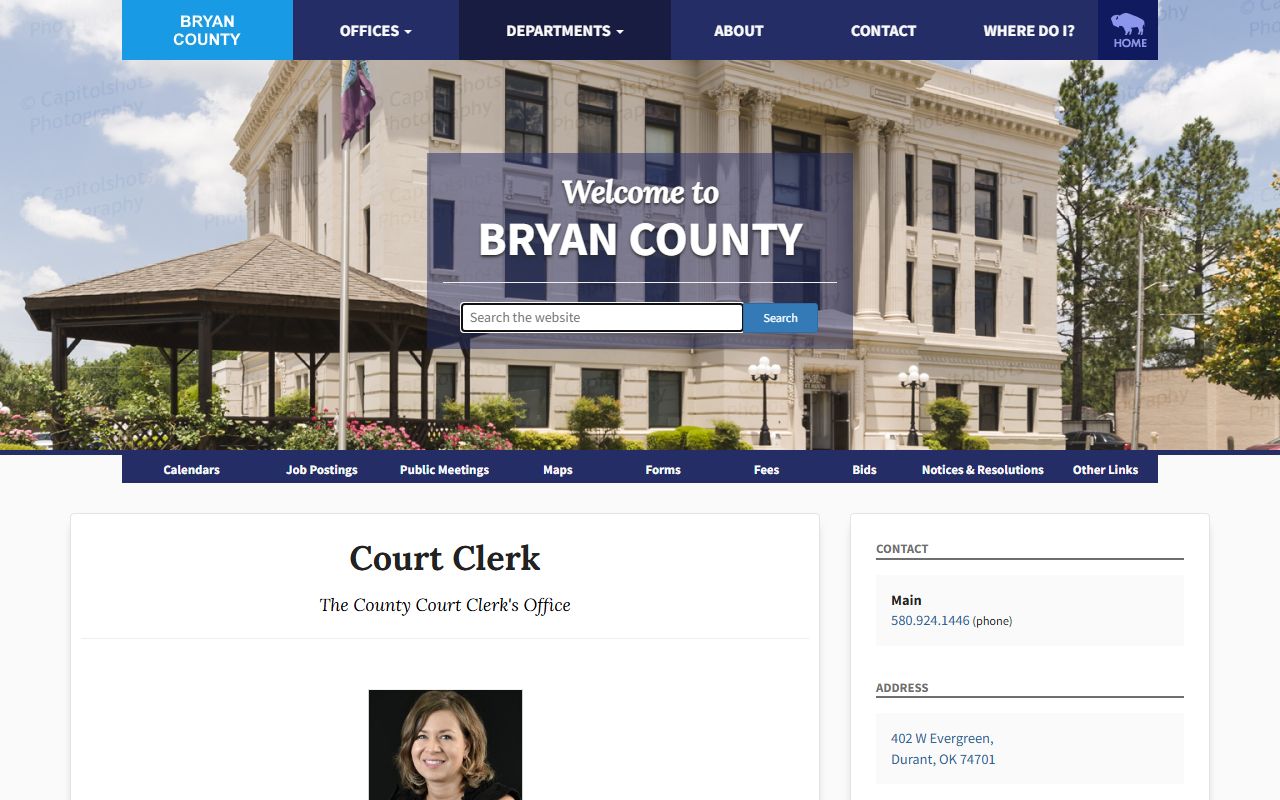
When ODCR does not show the expected case, the clerk's office is the local contact for district-court record questions, while the sheriff Records Division handles arrest, incident, and jail records not displayed online.